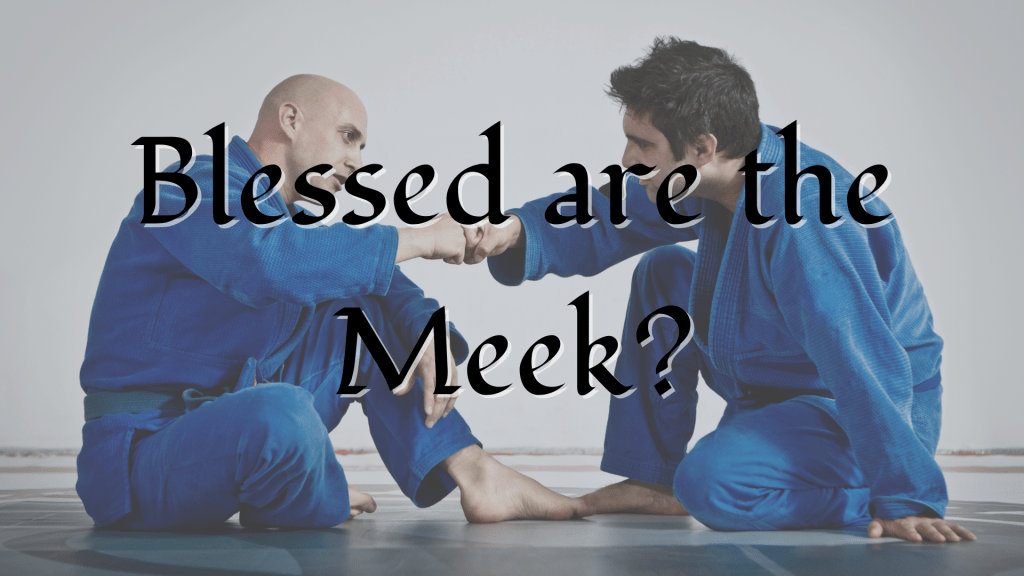
Meekness is the word of the month at the jiu jitsu gym where I train. Friends circled up after 30 mins of trying to choke each other, the concept of meekness went over our heads. At first glance meekness seems like weakness or submissiveness. One argues that it is not a masculine trait to be a door mat, and that’s true. But is that what it means to be meek? You only submit before you black out or to prevent breaking a joint.
It would seem then that meekness goes against everything we know about being a man.
The welsh preacher Martyn Lloyd-Jones said,
The world thinks in terms of strength and power, of ability, self-assurance and aggressiveness. That is the world’s idea of conquest and possession. The more you assert yourself and express yourself, the more you organize and manifest your powers and ability, the more likely you are to succeed and get on. (52)
Yes! That is how you win, by being default aggressive! Conquerors are not soft men that stayed home, but men who stepped into the arena and succeeded!
Yet, our Lord says “blessed are the meek for they will inherit the earth” (Matt 5:5). How is that possible? I, like many other men, struggle with understanding meekness, so this is a brief attempt at explaining it.
Meekness is Resilience
Here are two definitions of meekness.
The Easton Bible Dictionary says meekness is “a calm temper of mind, not easily provoked.”
The New International Encyclopedia of Biblical Words says the Greek words used in the New Testament for meek and meekness “picture a humble, gentle attitude that maintains patience despite offenses and is untainted by vengefulness or malice.”
That doesn’t sound like weakness to me. That sounds like resilience born from humility. That sounds like truer strength, being able to handle crap being flung in your direction without getting any on you. Being meek in the face of offense is not being soft, nice, or whimsical. It’s being able to to withstand the pressure without breaking.
Lloyd-Jones says,
Meekness is compatible with great strength. Meekness is compatible with great authority and power. … The meek man is one who may so believe in standing for the truth that he will die for it if necessary. The [early church] martyrs were meek, but they were never weak; strong men, yet meek men. (56)
Jesus is a perfect model for meekness with strength. He was falsely accused, tried illegally by the state which then beat and execute him. Hanging on the cross, crowds gathered on the road to mock him. Though the great Lion of Judah, he went as a lamb to be slaughtered. It was not uncommon for the crucified to try to pee on those who came to watch them die, shouting back insults, and attempting to salvage any vengeance in their death. Jesus didn’t do that. He didn’t shout back. He said it is finished. He said, “Father forgive them, for they know not what they do.”
… looking to Jesus, the founder and perfecter of our faith, who for the joy that was set before him endured the cross, despising the shame, and is seated at the right hand of the throne of God.
Hebrews 12:2 ESV
That’s the ultimate example of enduring offense but despising the shame of it. That is meekness, yet strength. And if it was suitable for Jesus then it’s suitable for you.
Meekness is Having Nothing to Prove
Meekness is a confidence that says you have nothing to prove. Marcus Aurelius said “Choose not to be harmed—and you won’t feel harmed. Don’t feel harmed—and you haven’t been,” and “The best revenge is not to be like that.”
When pushed, it is natural and normal to want to push back. When attacked, we want to counterattack. When insulted, we return fire. But what if the insults are true? What if, in rare, humble self-examination, we realize that maybe some of the things being said about us are both accurate and precise? If it’s true, then why take offense at it? To bear insult, even true insult, is stronger than to debase yourself by imitating that same behavior. Don’t take the bait, be meek.
And if the insults aren’t true, then why do you need to prove it? In a podcast with The Art of Manliness, Rener Gracie, a Brazilian jiu jitsu black belt from the most famous martial arts family that has ever existed, talked about going out to dance with his wife one night. The crowd was packed, and a drunk started getting rowdy bumping into many people and making the evening unpleasant. There was a confrontation, one that Gracie could have immediately won with skill and ease. Instead, he put his arm around this guy’s shoulder, squeezed it just enough to help get his point across, and suggested to the drunk that things calm down a bit. It worked. Everyone got on with their night without having to fight for it.
A soft answer turns away wrath, but a harsh word stirs up anger.
Proverbs 15:1 ESV
Gracie didn’t have to prove anything. He knew who he was, what skills he had, and what family he belonged to. With strength—and meekness—he dealt with the situation.
Meekness According to Rudyard Kipling
Rudyard Kipling captured the concept of meekness perfectly in his poem “If,” which are words from a father to his son on what it means to be a man. If poetry isn’t your thing then at least read the first stanza and then the last two lines (but also if you can’t tolerate poetry then you need to repent).
If you can keep your head when all about you
Are losing theirs and blaming it on you,
If you can trust yourself when all men doubt you,
But make allowance for their doubting too;
If you can wait and not be tired by waiting,
Or being lied about, don’t deal in lies,
Or being hated, don’t give way to hating,
And yet don’t look too good, nor talk too wise:If you can dream—and not make dreams your master;
If you can think—and not make thoughts your aim;
If you can meet with Triumph and Disaster
And treat those two impostors just the same;
If you can bear to hear the truth you’ve spoken
Twisted by knaves to make a trap for fools,
Or watch the things you gave your life to, broken,
And stoop and build ’em up with worn-out tools:If you can make one heap of all your winnings
And risk it on one turn of pitch-and-toss,
And lose, and start again at your beginnings
And never breathe a word about your loss;
If you can force your heart and nerve and sinew
To serve your turn long after they are gone,
And so hold on when there is nothing in you
Except the Will which says to them: ‘Hold on!’If you can talk with crowds and keep your virtue,
Or walk with Kings—nor lose the common touch,
If neither foes nor loving friends can hurt you,
If all men count with you, but none too much;
If you can fill the unforgiving minute
With sixty seconds’ worth of distance run,
Yours is the Earth and everything that’s in it,
And—which is more—you’ll be a Man, my son!
We need not be afraid of being meek men. It’s the hard path, to be humble and resilient, but we are called as men to do hard things. Let us not confuse weakness with strength, whether you’re a jiujiteiro, judoka, or just a regular dude, because the meek inherit the earth, not the arrogant.
What did I miss? How have you struggled with the concept of meekness? Let me know in the comments below. Feel free to subscribe to never miss my occasional posts.
Additional Reading and Works Cited
D. Martyn Lloyd-Jones, Studies in the Sermon on the Mount (Grand Rapids, MI: William B. Eerdmans Publishing Company, 1976).
Lawrence O. Richards, New International Encyclopedia of Bible Words: Based on the NIV and the NASB, Zondervan’s Understand the Bible Reference Series (Grand Rapids, MI: Zondervan Publishing House, 1999), 439.
M. G. Easton, Illustrated Bible Dictionary and Treasury of Biblical History, Biography, Geography, Doctrine, and Literature (New York: Harper & Brothers, 1893), 454.
Marcus Aurelius, Meditations, trans. Gregory Hays (New York: Modern Library, 2003).

 Awake! Put on strength!