
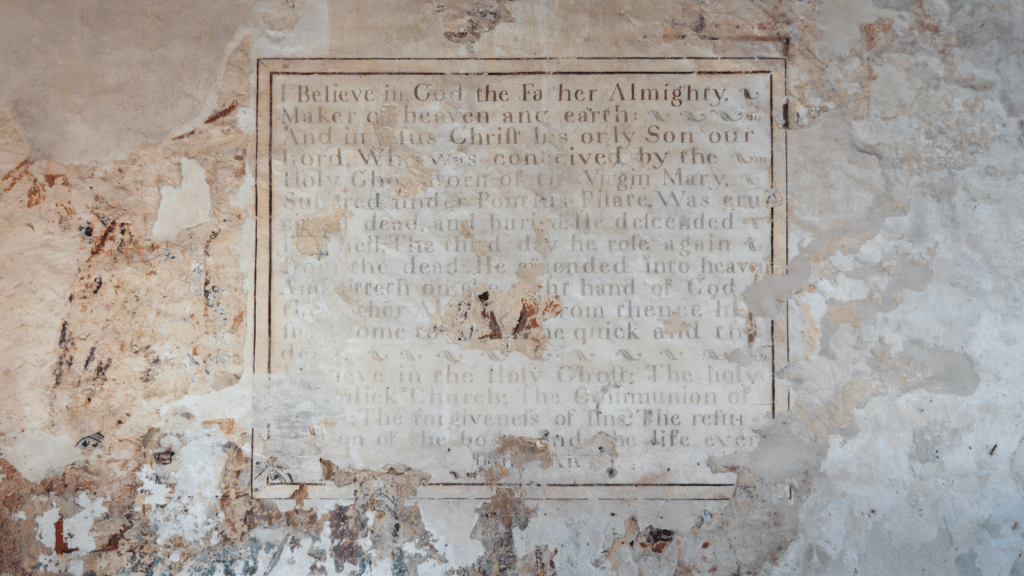
I’m going to start a new series where I will occasionally post some thoughts and meditations on various doctrinal and confessional standards, starting with the Westminster Shorter Catechism (WSC). I’ll call it Westminster Wednesdays or something like that. We catechize our son (see below for what that means) every night, singing songs made to help people memorize the questions. As he is learning, I am learning. I want them to be a part of my life as much as they are a part of his. I hope to expand this series to the Westminster Confession, the Heidelberg Catechism, and others.
Over the years I have shifted theologically in direct proportion to my exposure to the doctrines of grace. Rather than deconstruct, as is all too popular these days, I was reformed (pun intended). As I explore church history and the biblical theology behind my understanding of God’s Word, I want to invite you along with me.
I was raised in an evangelical, non-denominational church. When I went to college, I became a member of a Southern Baptist congregation and even attended the flagship seminary of the Southern Baptist Convention, Southern Seminary. During my time in seminary, I became a 1689 Reformed Baptist, but within the last few years, I have fully drank the covenantal Kool-Aid and am a Presbyterian (but not that kind).
A friend of mine who went before me in becoming Presbyterian (the axiom is true that Baptists make the best Presbyterians) suggested that as I read the WSC, I look up the Scripture proofs that the assembly provided back in the 1640s and see if I can follow their logic. So that is what I aim to do: I’ll take each question one at a time, look at the Scripture proofs, and write my thoughts on them.
But first, let’s discuss what catechisms, confessions, and creeds are because if, like me, you grew up in a religious tradition that didn’t have them, they might see foreign at best and dangerous at worst.
What is a Catechism?
A catechism is a teaching device using a question-and-answer format. It comes from the Greek word katecheo, which means “to teach” or “oral instruction.” Acts 18:25 says that Apollos “had been instructed in the way of the Lord. And being fervent in spirit, he spoke and taught accurately the things concerning Jesus … ” He was catechized, or taught, about God’s will, Word, and ways. Yet, we know from the context of that verse he had more to learn! And God sent Priscilla and Aquila to disciple him, which is the point of a catechism anyway.
Catechisms are more common in higher or formal congregations. The church I grew up in did not have a formal catechism, though there were informal substitutes in the form of Awana and Sunday School. However, it is not a “Catholic” thing, as some have suspected in Big Eva. Lutherans, Presbyterians, and even Reformed Baptists use them because it is a good way to teach theology and Scripture to a new convert, children and adults alike.
What is a Confession?
A confession of faith is a formal document that is the fruit of years of reflection and discussion. Generally, confessions of faith are denominational. Go to any church website or religious organization and you’ll see a version of this in the form of a statement of faith, which is more individual for them and not denomination-wide.
For Presbyterians, part of the standards that define them as a denomination is the Westminster Confession of Faith that was produced by order of parliament to help reform the church of England in the 1640s. Lutherans have The Augsburg Confession, which was drawn up for Holy Roman emperor Charles V by German nobles and clergy as a stand against the abuses of the pope and Catholic church.
Reformed Baptists (and some Southern Baptists) have the 1689 London Baptist Confession, which is a “lite” version of the Westminster Confession but without the baby-sprinkling. Largely Southern Baptists hold to a lesser statement of faith called The Baptist Faith and Message 2000. I call it lesser both because it’s weak sauce and because it sounds like the name of a 1950s dishwasher.
Confessions are just organized doctrines and beliefs about the Bible. They act as denominational guardrails or buoys which determine the doctrinal boundaries of a church. When churches within a denomination stray from their standards or even outright violate them, they can be challenged under church discipline. Sometimes splits happen, like with the Presbyterian church in the U.S. which formed the conservative Presbyterian Church of America and the liberal/progressive Presbyterian Church in the U.S.A. We are seeing that today with some Anglican synods and within the United Methodist Church.
What is a Creed?
Creeds are short confessions, basically a summary rather than a full-on confession, and are more general. Many of the early ecumenical creeds are widely held by churches across denominations, like the Apostles Creed, the Nicene Creed, and the Athanasian Creed. These aren’t controversial for Christians who are orthodox in their theology. But, it is very possible that many Christians today have not heard of them because they were not studied, recited, or used in their church tradition.
Why “No Creed but Jesus” is Wrong.
A major objection from some Protestants is the suspicion and false belief that having creeds, confessions, and catechisms means you don’t believe in the authority of the Bible, and are therefore Catholic. I’d say the opposite is true; confessions help us stay on target with the Bible. Reformed confessions help us protect against doctrinal shifts and bad interpretations of Scripture, by elevating Scripture above the authority of our own opinions. We are still Sola Scriptura but organized about it.
In this article, the good folks behind The Chorus in the Chaos say that it comes down to an issue of arrogance. When a person says “no creed but Christ,” they “aim to presume, if not intentionally, that no one before him has been able to see the truth of scripture. Such a person needs no ecumenical guidance in their doctrinal discernment – they are their own authority. … If we, in word and deed, deny the creeds and confessions, we also deny the clarity of scripture and God’s faithfulness to His church over the ages. The gospel is clear, understandable, and reliable; creeds and confessions evidence this.”
I also point you back up to my example of church discipline. Many people who call themselves Christians have varied opinions and beliefs about Christianity. For non-gospel issues that isn’t necessarily a big deal. However, for primary issues they are. I call the church down the street from us “fake Lutherans” because they no longer hold to Biblical truths found in their confessions of faith. The woke and progressive church dismisses Scripture, and their own theological traditions, by mocking God and his Word.
Which, is pretty dumb.
So join me as I work through the Westminster Shorter Catechism every Wednesday. To ensure you don’t miss out on this journey, subscribe to my website for articles directly in your inbox. You can also follow me on Facebook and Instagram.
Have you had experiences with catechisms or confessions in your spiritual journey? I invite you to share your stories with me and comment below with your thoughts and reflections.

 Awake! Put on strength!